


I spend much of my time analyzing my thoughts, treating them as separate objects that are independent of myself. I question not only the thoughts themselves but the why behind them and the reasoning that acts as their support structures. Understanding why I believe something can sometimes be a difficult task, but it’s a task that bears rich rewards if I don’t allow retreating to be an option. For instance, do I believe a thing that appears to be self-evident based on my own reasoning or do I believe it because I accepted it at face value as it appeared to be self-evident? Here’s an example: Are green apples green because I reasoned my way to that conclusion or did I simply rely on its face value and the fact everyone else agrees? There’s a subtle nuance in the question that will become more obvious as we continue.
A person who cannot step outside their own thought stream cannot notice that the stream has been shaped.
This type of exercise can seem fruitless and nonsensical to those who don’t spend much time thinking about their thinking. The system we operate within depends on a populace that exercises little metacognition — the ability to think about one’s thinking. It hopes that each individual will accept what appears to be obvious at face value, not through reasoning. The danger isn’t in believing a green apple is green based on its appearance. The danger lies in the habit that is formed by never coming to the conclusion an apple is green through one’s own reasoning abilities. We may simply accept what seems so “obvious” while failing to ever introduce rational thinking as guardrails for our beliefs. Thinking about one’s thinking will help produce the necessary protective measures to guard against impulsive or emotional responses. Such responses are what the sinister system feeds on, as a person who cannot step outside their own thought stream cannot notice that the stream has been shaped.
Metacognition paves the way to rational thinking and without it I’m not sure how a society can avoid decay. I believe the absence of rational thinking is behind the proliferation of the modern day echo chamber —carefully curated and indoctrinated tribes with most everyone believing they’re not indoctrinated. Sure, echo chambers have always existed, but not at the amplified levels we see today, which is made possible by our modern day technology. Our technology provides the rails that the echo chamber phenomenon rides on, treating every person with access to a screen as a destination. As it arrives, the echoes attempt to drown out one’s ability to reason and think for themselves by providing information that is “most obvious” to those inside the chamber. Those who exist inside of opposing echo chambers believe their perspective of the world is not only correct, but self-evident and obvious. To both sides, the apple is green because it is obviously green. It stands to reason that two parties with diametrically opposing views can’t both be right. However, it is possible they are both wrong.
I hold a belief that I’m sure may seem very hyperbolic when I state that I see no way that a society —let alone the human species—can survive when its people no longer use reason to arrive at proper conclusions. When such conclusions become ideas held by deeply dogmatic persons an entire society will fracture. The inability to discern the failure modes in how one thinks, recognize biases, and step outside of one’s self eventually leads to moral decay and destruction of self. I often see seeds of this behavior when I hop online to check current events each day. Platforms that once stood for a certain principle have now fallen to the destructive disease of low metacognition. Thousands, if not millions of people, screaming into their echo chambers to “combat the noise from the other side” all failing to realize they’ve all been infected, while hubris disallows the ability to come to reason. It’s not me, it’s them, everyone believes.
What has made matters worse is the rise of artificial intelligence. I believe the dark spiritual purveyors of man’s fateful destiny now utilize AI to prey on a human population that has been primed to jettison the ability to sit with one’s own thoughts. Existing in silence, ditching the screens, or simply abstaining from social media can be anxiety-inducing for many people. Everyone wants more content regardless of its shape. For example, there used to be a time where the greatest fear was misinformation. However, the ante has been upped. Now, the internet is continuously supplied with a steady stream of content and information that is not even real, yet it’s all still highly desired. It is one thing to have one’s reality shaped by misinformation —which is not always intended to deceive. It’s another thing to have one’s reality completely replaced by what I call The Synthetic —a world where all things that were once real and full of life have become replaced with the artificial and lifeless.
Just as technology provides the rails for echo chambers, low metacognition provides the rails for deception. The inability to reason about one’s reasoning provides a breeding ground for all manner of falsehoods to take root in an individual’s life. As this problem begins to scale across cities, states, and nations, the world may find itself blanketed in deception —an idea that sounds farfetched until we remember what was taking place during the days of Noah. The most obvious problem with being deceived is the inability to discern that you have in fact, been deceived. Rarely does one ever admit to being deceived. In my experience most people double down on their beliefs as a way to avoid the embarrassment of being wrong. Plus, it is easier to find someone inside the echo chamber who will always agree no matter how falsifiable an idea may be. Today’s technology makes this possible and it’s meant to operate like floodgates that can never be closed. The constant barrage of content seeking clicks and views works to overload and over-stimulate the brain to such a degree it has no time to think about its thinking. It is akin to a distributed denial-of-service (DDoS) attack that aims to overwhelm and crash a website’s network. When the day is over, you’ll most likely not remember much about the content you ingested, but your belly will be full.
Despite the influence of social media platforms and the derangement of the mainstream media (MSM) industrial complex, the actual attack on cognition really ramped up a few decades ago. Back when I used to debate non-believers in an attempt to bring people to the foot of the cross I’d meet people who were staunch relativists. They were the educated and bright pupils from university ready to tackle the world with their “facts and knowledge” —something they argued the Christian lacked. Yet, they were never able to reconcile the fact that relativism —a position that rejects absolutes— was a self-defeating position to start with, as it takes an absolute position that there are in fact, no absolutes. I wasn’t alone in recognizing this new phenomenon that also arose with the ideas of universalism, postmodernism, moral relativism, and subjectivism in the early 2000s. Back then, I used to listen to a podcast formerly known as Way of the Master where its hosts would frequently visit college campuses to share the Gospel. From the mouths of young adults who were paying good money to attend fine schools you’d hear the most ridiculous ideas. To hear someone state that “whatever you believe in is true for you but not for me” wasn’t a rare occurrence. I was amazed this was taking place on college campuses across the country. These were the “bright minds” academia was shaping —for an astronomical fee of course. Back then I knew seeds of deception were being planted within the walls of universities and that in the future these seeds would sprout, wreaking havoc on our future society.
Being educated is not a defense against deception. A fool filled with all the wrong knowledge is still a fool. I am a firm believer that university simply institutionalized knowledge for the sole purpose of producing cogs to empower the system that controls us. A place where what to think takes precedence over how to think. I’m not arguing that everyone who attended university is a cog. I’m arguing what I believe is the purpose behind institutionalizing what should be freely received if sought —the world’s knowledge and information. Thanks to the advancement of the internet the paradigm shift is taking place and we’ve been witnessing the democratization of information, freeing the world’s knowledge from the prisons that have held it hostage. Today it’s common to see professors —secular and non— offer their knowledge through educational platforms in tightly packed courses for a nominal fee comparable to the cost of a degree. The great library of Alexandria is being reborn, but there’s a problem. Societies within developed nations are losing their cognitive abilities despite the democratization of the world’s information. This isn’t hyperbole or fear-mongering.
The 20th century rise in population intelligence —also known as the Flynn effect— has been shown to be reversing. A landmark study of 730,000 Norwegian men (Bratsberg & Rogeberg, 2018, PNAS) found both the rise and the reversal are driven by environmental causes, not genetics.
A separate study —sampling between 2006 and 2018— found a steady decline in almost every metric of a 35-item assessment in an American population with the exception of 3D rotation (spatial reasoning).
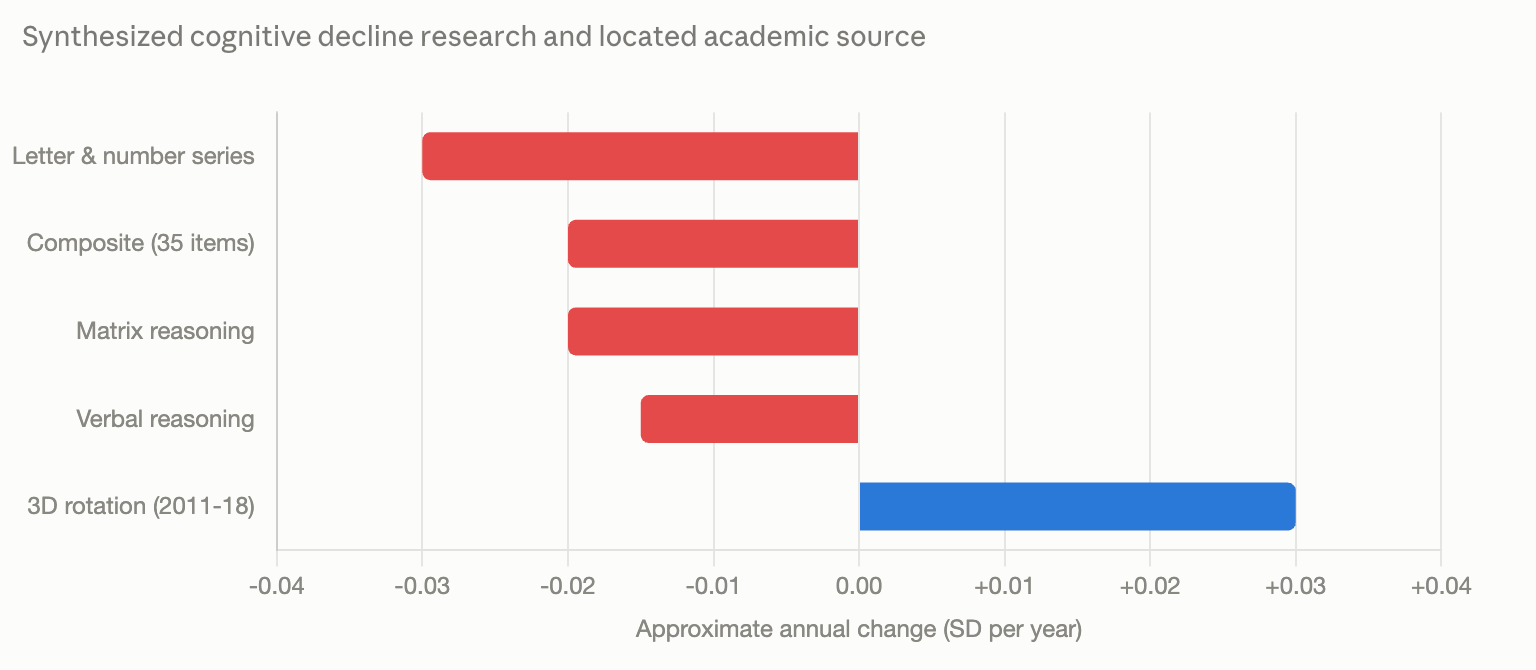
This study includes adults only and is pre-COVID. It appears that spatial/visual skills honed by screens are rising while verbal and sequential reasoning are eroding. Scientists currently believe that the very same technology that helped generate the Flynn effect is now reversing it.
The domains that are in decline are necessary for sustained argumentation and abstract thinking. If you’ve noticed over the last few decades a degradation in people’s ability to hold civilized debates —everyone constantly talking past each other— this is why. Cognitive decline is a real phenomenon. In the absence of verbal and matrix reasoning people will resort to more screaming into the void and less problem solving through reasoning and civility. It is much easier to vent frustrations, lash out, and finger point than to become an active participant in solving complex societal problems. We are all being conditioned to be rendered obsolete by the machine aside from our one main benefit —energy expenditure to keep the system going.
We must ask ourselves what the future of a species in cognitive decline holds. I believe it is imperative that we all pause and formulate a routine that encourages us to think about our thinking so that we can be sure our thoughts and ideas are born of sound reason. We should do all that we can to institute guardrails around our minds and an auditing system to keep us honest.
Here are a few things from my cognitive framework:
Questions to ask
Why do I believe this?
Did I reason my way to this belief and if so, what were my steps?
Am I viewing this scenario, statement, or argument emotionally?
Have I taken the time to truly consider and understand “the others” position without trying to be right?
Am I trying to win the person or the argument?
Am I operating through the lens of objectivity that is not my own and is divinely transcendent?
Things to do
Allow the brain to decompress throughout the day with a permanent decompression starting in the early evening. Decompress means to find solace in silence and boredom. Go outside. Listen to the wind and the birds. Dim the lights at night. Enjoy darkness and its peace. Allow the brain to filter the day’s thoughts and emotions appropriately. Think of it as grounding for the brain and a way to avoid losing one’s humanity to the machine.
Challenge your thinking, because no-one will and the system relies on your inability to do so.
Thank you for reading. If you enjoyed it, please restack and share it. Feel free to leave comments as I’d love to hear your thoughts. - Gideon
The Dark Realm Podcast: YouTube | Spotify | Apple Podcasts